Abstract
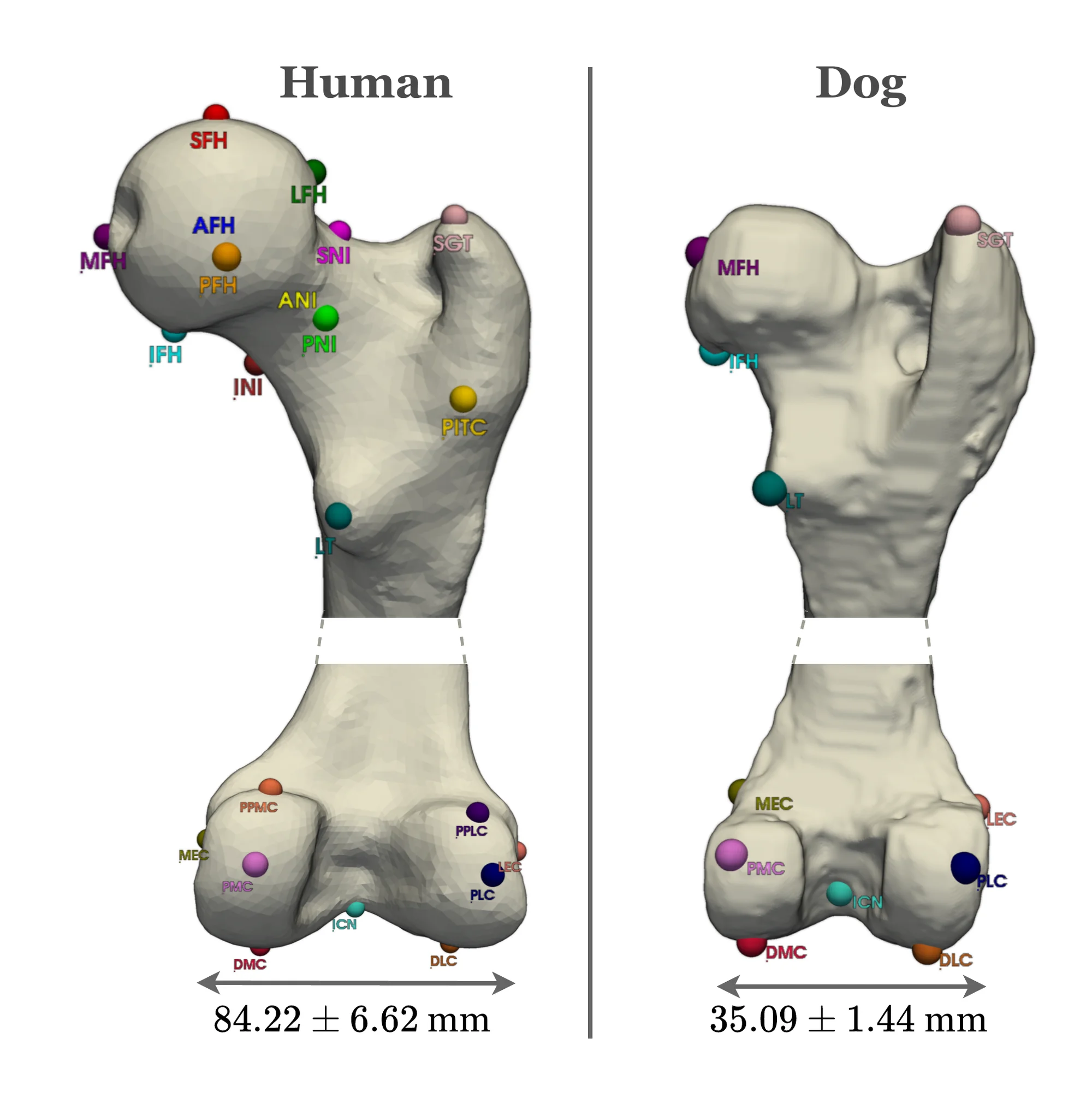
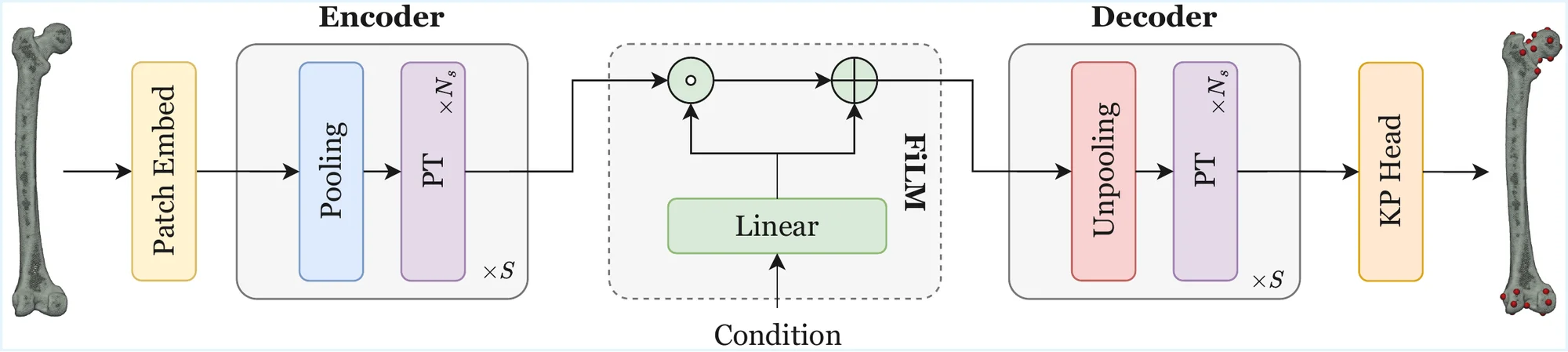
Accurate identification of anatomical landmarks is crucial for various medical applications. Traditional manual landmarking is time-consuming and prone to inter-observer variability, while rule-based methods are often tailored to specific geometries or limited sets of landmarks. In recent years, anatomical surfaces have been effectively represented as point clouds, which are lightweight structures composed of spatial coordinates. Following this strategy and to overcome the limitations of existing landmarking techniques, we propose Landmark Point Transformer (LmPT), a method for automatic anatomical landmark detection on point clouds that can leverage homologous bones from different species for translational research. The LmPT model incorporates a conditioning mechanism that enables adaptability to different input types to conduct cross-species learning. We focus the evaluation of our approach on femoral landmarking using both human and newly annotated dog femurs, demonstrating its generalization and effectiveness across species.
Method Overview
Citation
@inproceedings{bastico2026lmpt,
  author    = {Bastico, Matteo and Onghena, Pierre and Ryckelynck, David and Marcotegui, Beatriz and Velasco-Forero, Santiago and Cort{\'e}, Laurent and Robine-Decourcelle, Caroline and Decenci{\`e}re, Etienne},
  booktitle = {2026 IEEE 23rd International Symposium on Biomedical Imaging (ISBI)},
  title     = {{LmPT}: Conditional Point Transformer for Anatomical Landmark Detection on {3D} Point Clouds},
  year      = {2026},
  pages     = {1--5},
  publisher = {IEEE},
  doi       = {10.1109/ISBI61048.2026.11515617}
}